

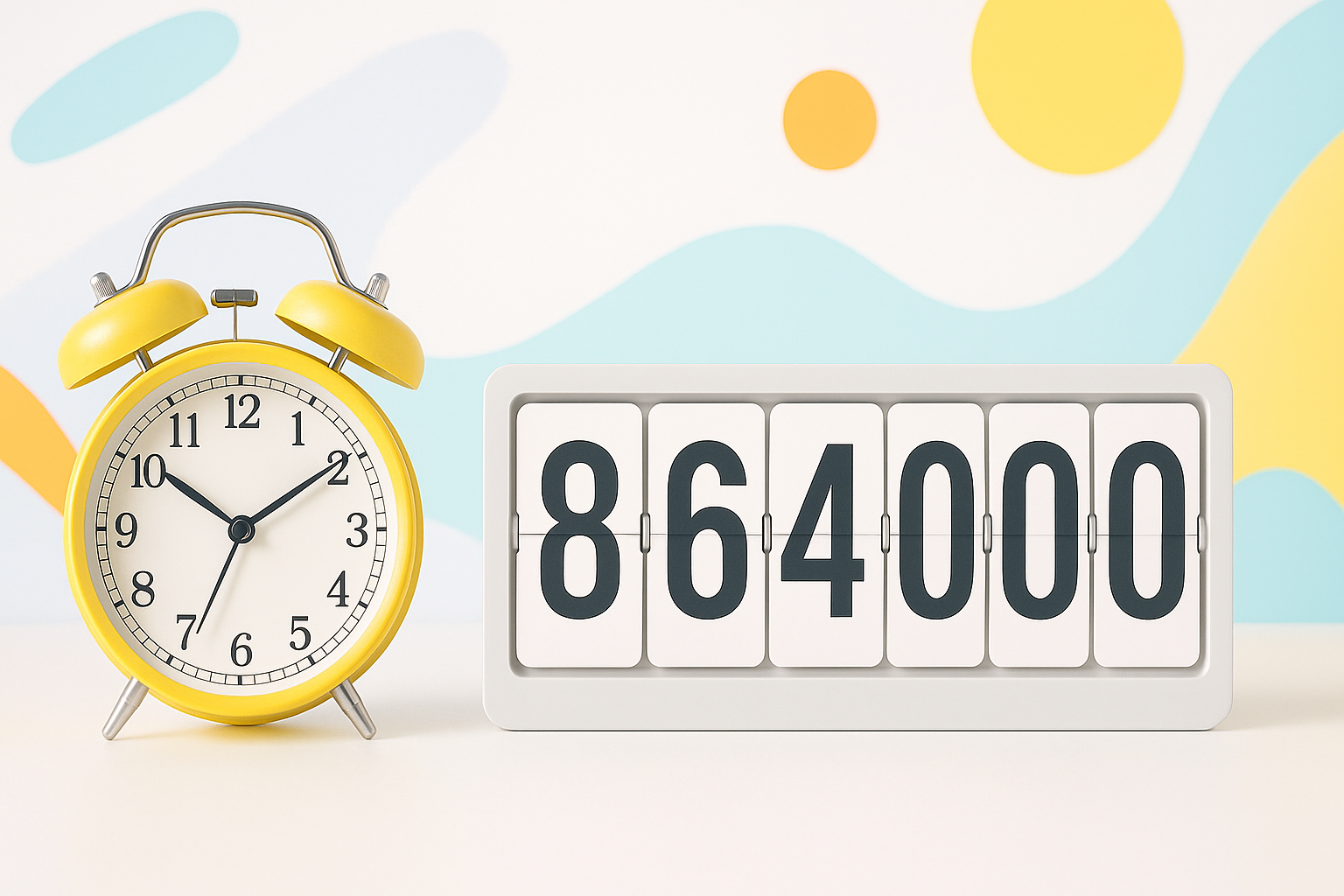
Ever found yourself staring at the clock, wondering exactly how many seconds tick by in a single day? Whether you’re calculating time zones, planning schedules, or just satisfying your curiosity, understanding how many seconds in a day can be surprisingly useful in our time-obsessed world.
The answer is straightforward: there are exactly 86,400 seconds in a standard 24-hour day. But behind this simple number lies a fascinating world of time measurement, astronomical precision, and practical applications that affect everything from computer systems to space exploration.
Breaking Down the Basic Calculation
Let’s walk through the math step by step. The calculation for determining daily seconds follows a simple multiplication pattern:
- 60 seconds in one minute
- 60 minutes in one hour
- 24 hours in one day
So the formula becomes: 60 × 60 × 24 = 86,400 seconds
This calculation assumes we’re working with a standard day. But here’s where things get interesting – not all days are created equal from an astronomical perspective.
Why Knowing Daily Seconds Matters More Than You Think
Understanding time in seconds isn’t just academic curiosity. This knowledge plays a crucial role in several areas:
Computer Programming and Systems
Developers frequently work with timestamps measured in seconds since a reference point (often January 1, 1970, known as Unix time). Knowing daily second counts helps calculate time differences and schedule automated tasks.
Financial Markets
Trading algorithms and market analysis often require precise time calculations. A single second can mean millions of dollars in high-frequency trading environments.
Scientific Research
Researchers studying everything from particle physics to climate patterns need accurate time measurements. Daily second calculations help synchronize experiments and data collection across different time zones.
The Reality of Earth’s Rotation
Here’s where our neat 86,400-second day gets complicated. Earth’s rotation isn’t perfectly consistent. Our planet actually experiences slight variations in its rotational speed due to several factors:
- Gravitational pull from the moon and sun
- Atmospheric pressure changes
- Ocean currents and tides
- Geological events like earthquakes
These variations are tiny – we’re talking milliseconds – but they’re significant enough that scientists occasionally add “leap seconds” to keep our clocks synchronized with Earth’s actual rotation.
Leap Seconds and Time Corrections
Since 1972, timekeepers have added 27 leap seconds to Coordinated Universal Time (UTC). These additions mean some days have actually contained 86,401 seconds instead of the standard 86,400.
The last leap second was added on December 31, 2016, and while they’re becoming less frequent, the possibility remains for future adjustments.
Time Calculations Across Different Periods
Once you know there are 86,400 seconds in a day, you can easily calculate longer time periods:
| Time Period | Total Seconds |
| 1 Week | 604,800 |
| 1 Month (30 days) | 2,592,000 |
| 1 Year (365 days) | 31,536,000 |
| 1 Leap Year (366 days) | 31,622,400 |
These calculations become particularly useful for project planning, data analysis, and understanding the scale of time in various contexts.
Practical Applications in Daily Life
You might wonder when you’d actually need to know daily second counts. The applications are more common than you might expect:
Fitness and Health Tracking
Many fitness apps calculate daily activity by measuring seconds of movement, rest, and exercise. Understanding the total seconds available helps set realistic activity goals.
Productivity Analysis
Time management experts often break down daily productivity by examining how seconds and minutes are spent across different activities.
Media and Content Creation
Video editors, podcasters, and content creators frequently work with precise timing measurements when planning daily content schedules.
Historical Context and Measurement Evolution
The concept of dividing days into hours, minutes, and seconds has ancient roots. The Babylonians developed the base-60 system that still influences our time measurements today.
However, the precise definition of a second has evolved significantly. Originally based on Earth’s rotation, the official definition now relies on atomic vibrations – specifically, 9,192,631,770 cycles of radiation from cesium-133 atoms.
This atomic definition ensures incredible precision, making our 86,400-second day calculation accurate to within nanoseconds for practical purposes.
Global Time Zone Considerations
While every location experiences the same 86,400 seconds in a day, time zones create interesting complications for global coordination.
When it’s noon in New York, it’s already 5 PM in London – same 24-hour period, different local times. This reality makes second-based calculations invaluable for international business, communications, and travel planning.
Some regions also observe daylight saving time, which creates days with 25 hours (90,000 seconds) or 23 hours (82,800 seconds) twice yearly.
Technology and Timekeeping Precision
Modern technology demands incredible timing precision. GPS satellites, for instance, must account for relativistic effects that cause their atomic clocks to run differently than Earth-based clocks.
Internet protocols, database systems, and distributed computing all rely on precise time synchronization measured in seconds and fractions of seconds.
Even your smartphone coordinates with network time servers multiple times daily to maintain accuracy within milliseconds of official time standards.
The Future of Time Measurement
Scientists continue refining time measurement techniques. Optical atomic clocks now achieve precision beyond current cesium-based standards, potentially leading to even more accurate definitions of time units.
These advances might eventually change how we calculate and understand daily time periods, though the fundamental 24-hour day structure will likely remain constant for practical purposes.
Understanding that each day contains exactly 86,400 seconds provides a foundation for countless practical applications, from simple scheduling to complex scientific calculations. This seemingly basic piece of knowledge connects us to centuries of human timekeeping innovation while remaining endlessly useful in our modern, time-conscious world.
Next time you glance at a clock, remember that you’re witnessing one moment in a precise 86,400-second cycle that has repeated billions of times throughout Earth’s history – and will continue long into the future.
