

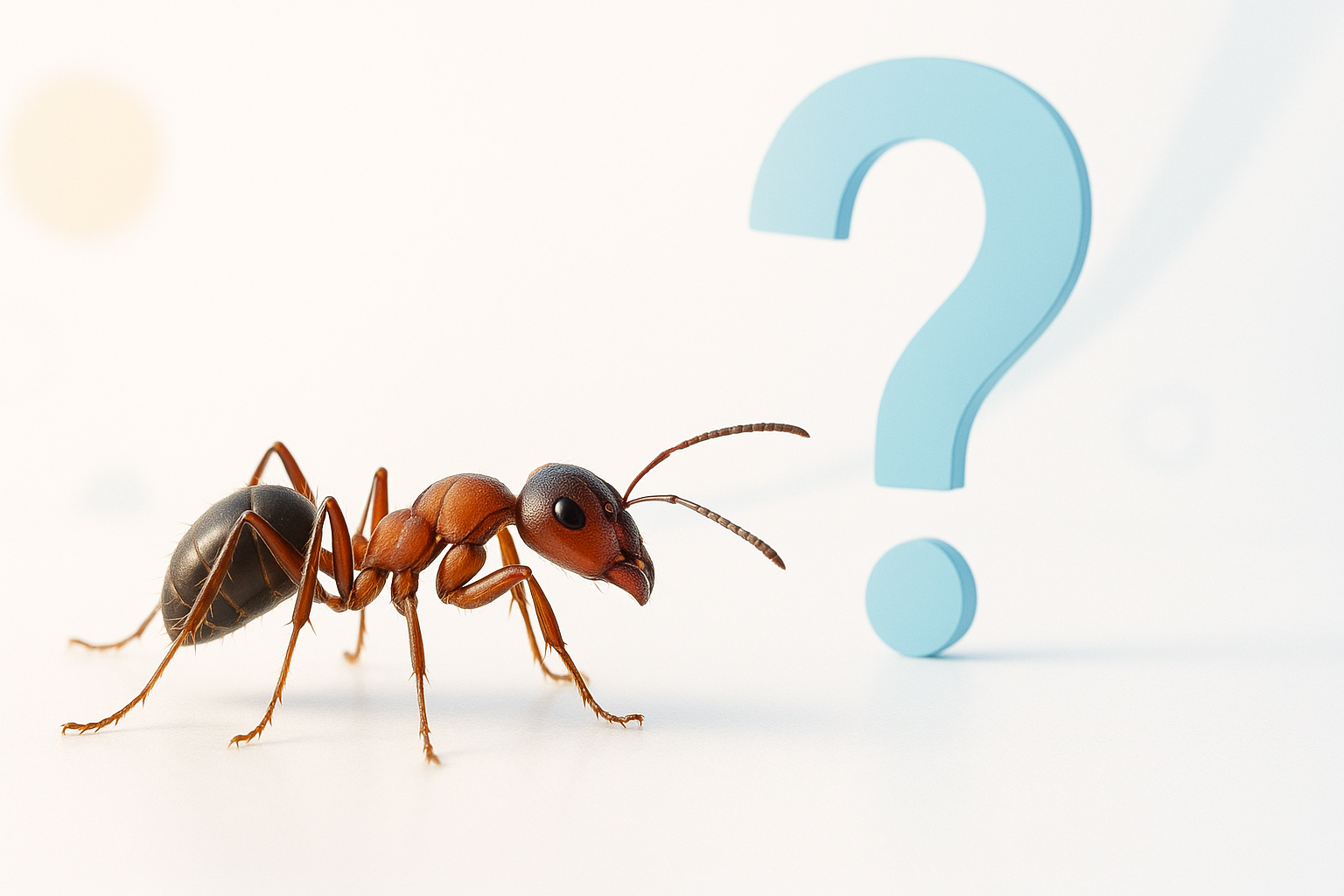
The Simple Answer That Opens a Complex World
Every ant crawling across your kitchen counter or marching through your garden has exactly six legs. This might seem like basic biology, but understanding how many legs do ants have leads us into fascinating territory about evolution, biomechanics, and the incredible success of these tiny creatures.
Those six legs aren’t just random appendages. They’re precision-engineered tools that have helped ants become one of the most successful groups of animals on Earth, representing nearly 20% of all terrestrial animal biomass.
Why Six Legs Make Perfect Sense
Ants belong to the class Insecta, and like all insects, they follow the fundamental body plan that emerged millions of years ago. The hexapod design—six legs arranged in three pairs—offers remarkable advantages that become clear when you watch ants in action.
The tripod gait system allows ants to maintain stability while moving efficiently. At any given moment, three legs form a stable triangle touching the ground while the other three lift and move forward. This creates continuous motion without sacrificing balance, even when carrying loads many times their body weight.
Consider how this differs from other creatures. Spiders with eight legs can afford to lose one or two and still function normally. Mammals with four legs struggle significantly with even minor leg injuries. But ants have struck the perfect balance between stability and efficiency.
The Anatomy Behind Ant Locomotion
Each of an ant’s six legs consists of several segments that work together like a sophisticated mechanical system:
- Coxa: The hip joint that connects to the body
- Trochanter: A small connecting segment
- Femur: The upper leg segment, similar to a thigh
- Tibia: The lower leg segment, like a shin
- Tarsus: The foot, usually divided into multiple segments
- Pretarsus: The final segment with claws for gripping
This segmented structure provides incredible flexibility and strength. The joints between segments allow for complex movements, while the rigid segments themselves can support tremendous weight relative to the ant’s size.
How Ants Use Their Six Legs for More Than Walking
Viewing ant legs merely as walking tools dramatically underestimates their versatility. These appendages serve multiple crucial functions that contribute to ant colonies’ remarkable success.
Construction and Engineering
Worker ants use their legs as precision tools when building nests. They can manipulate individual grains of sand, position twigs with millimeter accuracy, and even form living chains with their legs to bridge gaps during construction projects.
Some species create living rafts during floods, linking their legs together to form waterproof platforms that protect the colony’s queen and larvae. This behavior demonstrates how six legs provide enough connection points for complex social engineering projects.
Food Processing and Transport
Ants often use their front legs like hands, holding food items while their mandibles break them into manageable pieces. The middle and rear legs maintain stability and locomotion while the front legs handle delicate manipulation tasks.
When transporting large food items, multiple ants coordinate their leg movements to carry objects that would be impossible for individual ants to move. This cooperative lifting requires precise timing and communication between the legs of different ants.
The Evolutionary Advantage of Six Legs
The six-legged body plan appeared early in arthropod evolution and proved so successful that it’s remained virtually unchanged for hundreds of millions of years. This stability suggests that six legs represent an optimal solution for terrestrial locomotion at small scales.
Computer simulations of various leg configurations consistently show that six legs provide the best combination of speed, stability, and energy efficiency for creatures in the ant size range. Fewer legs reduce stability and carrying capacity, while more legs add weight and complexity without proportional benefits.
The arrangement of ant legs also contributes to their incredible strength-to-weight ratios. By distributing loads across three pairs of legs, ants can lift objects 10 to 50 times their own body weight—a feat that would be impossible with different leg configurations.
Comparing Ant Legs Across Different Species
While all ants share the basic six-leg structure, different species have evolved remarkable variations adapted to their specific lifestyles and environments.
| Ant Type | Leg Adaptations | Special Function |
| Army Ants | Strong, hook-like claws | Linking together to form bridges and rafts |
| Leafcutter Ants | Powerful, precise front legs | Cutting and carrying leaf fragments |
| Desert Ants | Long, stilted legs | Elevating body above hot sand surfaces |
| Trap-jaw Ants | Reinforced leg joints | Absorbing shock from high-speed jumps |
These adaptations show how the basic six-leg template can be modified for specialized purposes while maintaining the fundamental advantages of the hexapod design.
What Happens When Ants Lose Legs?
Ants can survive and function with fewer than six legs, though their efficiency decreases significantly. Research shows that ants can adapt their gait patterns when missing one or even two legs, though they move more slowly and carry lighter loads.
The loss of legs affects different functions depending on which legs are missing. Front leg injuries impair food manipulation and nest construction activities. Middle leg damage reduces overall stability and speed. Rear leg loss affects the ant’s ability to push off effectively during locomotion.
Interestingly, ants don’t regenerate lost legs the way some other arthropods do. Once a leg is gone, the ant must adapt its behavior and movement patterns to compensate for the loss.
The Physics of Six-Legged Movement
The mechanics of how ants coordinate their six legs reveals sophisticated neural control systems. Each leg operates somewhat independently, but they must coordinate precisely to achieve smooth, efficient movement.
Ants use a combination of sensory feedback and programmed motor patterns to control their legs. Sensors in each leg detect ground contact, load, and position, while the nervous system integrates this information to maintain proper gait timing.
This distributed control system makes ants remarkably adaptable to different terrains and conditions. They can seamlessly transition from horizontal surfaces to vertical walls, adjust their gait for different loads, and maintain coordination even in challenging environments.
Why This Matters Beyond Basic Biology
Understanding how many legs do ants have and how they use them has practical applications in robotics, materials science, and engineering. Researchers study ant locomotion to design more efficient walking robots, and the principles of six-legged movement inform everything from Mars rovers to search-and-rescue robots.
The cooperative behavior enabled by ant leg structure also provides insights into swarm intelligence and collective problem-solving. These principles influence algorithm design, logistics optimization, and even traffic flow management.
Next time you see ants marching across your sidewalk, you’re witnessing millions of years of evolutionary optimization in action. Those six legs represent one of nature’s most successful engineering solutions, refined through countless generations to achieve remarkable efficiency and versatility. Understanding this simple fact—that ants have six legs—opens a window into the complex and fascinating world of biomechanics, evolution, and the incredible capabilities of some of our smallest neighbors.
