

The Fundamental Building Block: Understanding Neutron Mass
Deep within every atomic nucleus, neutrons serve as the silent workhorses that hold our universe together. These electrically neutral particles play a crucial role in nuclear stability, yet many people wonder: what is the mass of a neutron exactly?
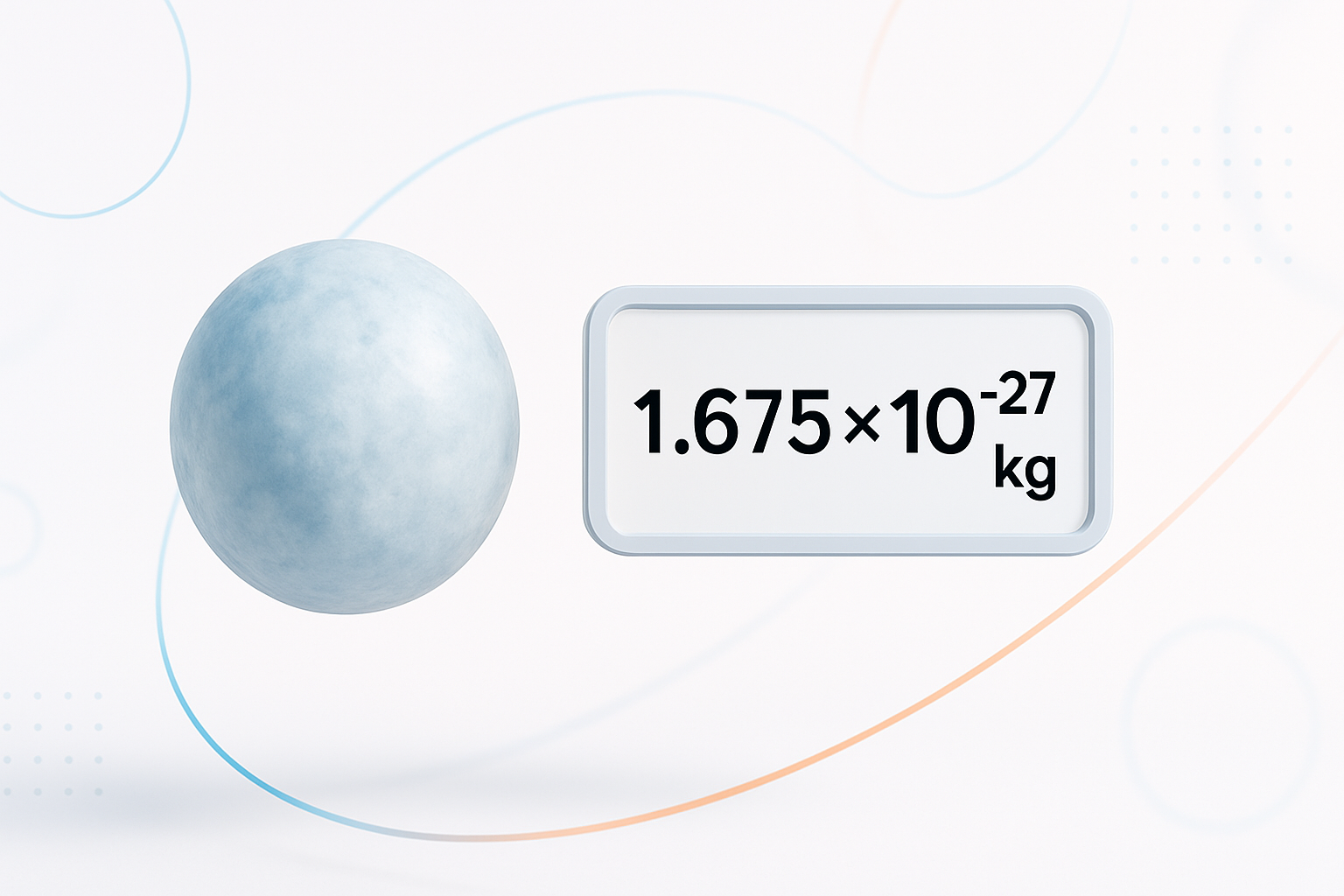
A neutron weighs approximately 1.675 × 10⁻²⁷ kilograms, or about 1.009 atomic mass units (amu). To put this in perspective, a neutron is roughly 1,839 times heavier than an electron and slightly more massive than its nuclear companion, the proton.
This seemingly simple measurement represents decades of scientific research and has profound implications for our understanding of matter, energy, and the very fabric of reality.
Measuring Something You Cannot See
Determining neutron mass required ingenious experimental techniques since these particles cannot be observed directly. Scientists initially discovered neutrons in 1932 through nuclear bombardment experiments, but measuring their precise mass proved far more challenging.
Early measurements relied on nuclear reaction studies where researchers analyzed the energy and momentum changes during particle collisions. By carefully measuring the masses of reactants and products in nuclear reactions involving neutrons, physicists could calculate the neutron’s mass through conservation laws.
Modern techniques use sophisticated mass spectrometry and atomic beam methods. These approaches can measure neutron mass with extraordinary precision—down to parts per billion.
Breaking Down Neutron Mass: The Complete Picture
Understanding neutron mass requires looking at several different measurement systems that scientists use:
Standard International Units
- Kilograms: 1.67492749804 × 10⁻²⁷ kg
- Grams: 1.67492749804 × 10⁻²⁴ g
Atomic and Nuclear Physics Units
- Atomic mass units: 1.00866491588 u
- Electron volts: 939.565420 MeV/c²
The atomic mass unit proves particularly useful because it’s defined as exactly 1/12 the mass of a carbon-12 atom. This makes it easier to compare masses of different subatomic particles and atomic nuclei.
How Neutron Mass Compares to Other Particles
Neutrons exist in a fascinating middle ground between other fundamental particles. Here’s how they stack up:
| Particle | Mass (amu) | Relative to Neutron |
| Electron | 0.000549 | 1,839 times lighter |
| Proton | 1.007276 | 0.14% lighter |
| Neutron | 1.008665 | Reference point |
| Hydrogen atom | 1.007825 | 0.08% lighter |
The small but significant mass difference between protons and neutrons has enormous consequences for nuclear physics and stellar processes.
Why Neutron Mass Matters More Than You Think
That tiny mass difference between neutrons and protons—just 1.3 MeV/c²—shapes the entire universe as we know it. This mass differential drives beta decay, where neutrons transform into protons, electrons, and neutrinos.
In stellar cores, this mass difference determines whether stars can sustain nuclear fusion or collapse into neutron stars. The precise value affects nucleosynthesis—the process by which elements form in stars—and ultimately influences which elements exist in abundance throughout the cosmos.
Nuclear engineers rely on accurate neutron mass values when designing reactors and calculating reaction energies. Even small uncertainties in neutron mass could compound into significant errors in reactor safety calculations.
The Internal Structure Behind the Mass
Neutrons aren’t elementary particles—they’re composite structures made of quarks bound together by the strong nuclear force. Specifically, each neutron contains:
- One “up” quark (charge +2/3)
- Two “down” quarks (charge -1/3 each)
- Binding energy from gluons
Surprisingly, the quarks themselves contribute only about 1% of the neutron’s total mass. The remaining 99% comes from the binding energy that holds the quarks together—a direct demonstration of Einstein’s famous E=mc² equation.
This means neutron mass primarily reflects the energy stored in quantum field fluctuations within the particle, not the “stuff” the neutron is made from.
Recent Discoveries and Measurement Refinements
Scientists continue refining neutron mass measurements using increasingly sophisticated techniques. Recent experiments have achieved precision levels better than one part in 10 billion, revealing subtle details about neutron properties.
One breakthrough came from studying ultracold neutrons—neutrons cooled to temperatures near absolute zero where they move slowly enough for precise manipulation. These experiments have improved mass measurements and revealed new insights into neutron behavior.
Researchers have also used neutron interferometry, where quantum mechanical wave properties of neutrons create interference patterns that depend sensitively on neutron mass. This technique provides independent verification of traditional mass spectrometry results.
Practical Applications in Science and Technology
Accurate knowledge of neutron mass enables numerous practical applications:
Medical Applications
Neutron therapy for cancer treatment requires precise dose calculations based on neutron mass and energy. Medical physicists use these values to ensure patients receive exactly the right radiation dose while minimizing damage to healthy tissue.
Materials Science
Neutron scattering techniques help scientists study material properties at the atomic level. The neutron’s mass determines how it interacts with atomic nuclei, affecting the interpretation of scattering experiments.
Nuclear Security
Detection systems for nuclear materials rely on neutron signatures. Understanding neutron mass helps engineers design more sensitive detectors for preventing nuclear smuggling.
Future Research Directions
Scientists continue pushing the boundaries of neutron mass precision. Next-generation experiments aim to measure neutron properties with even greater accuracy, potentially revealing new physics beyond our current understanding.
Some researchers investigate whether neutron mass might vary slightly under extreme conditions, such as in neutron star cores where matter reaches densities impossible to recreate on Earth.
Others explore connections between neutron mass and fundamental constants of nature, searching for clues about why the universe has the properties it does.
The Bigger Picture
What started as a simple question about neutron mass opens doorways to some of the deepest mysteries in physics. From the quantum structure of matter to the evolution of stars, neutron mass influences phenomena across all scales of the universe.
The precise value of 1.008665 atomic mass units represents far more than just a number—it encodes information about the fundamental forces that govern reality. Every time scientists refine this measurement, they gain deeper insights into the nature of matter, energy, and the cosmos itself.
Understanding what determines the mass of a neutron continues driving scientific discovery, pushing us toward a more complete picture of the universe and our place within it.
