

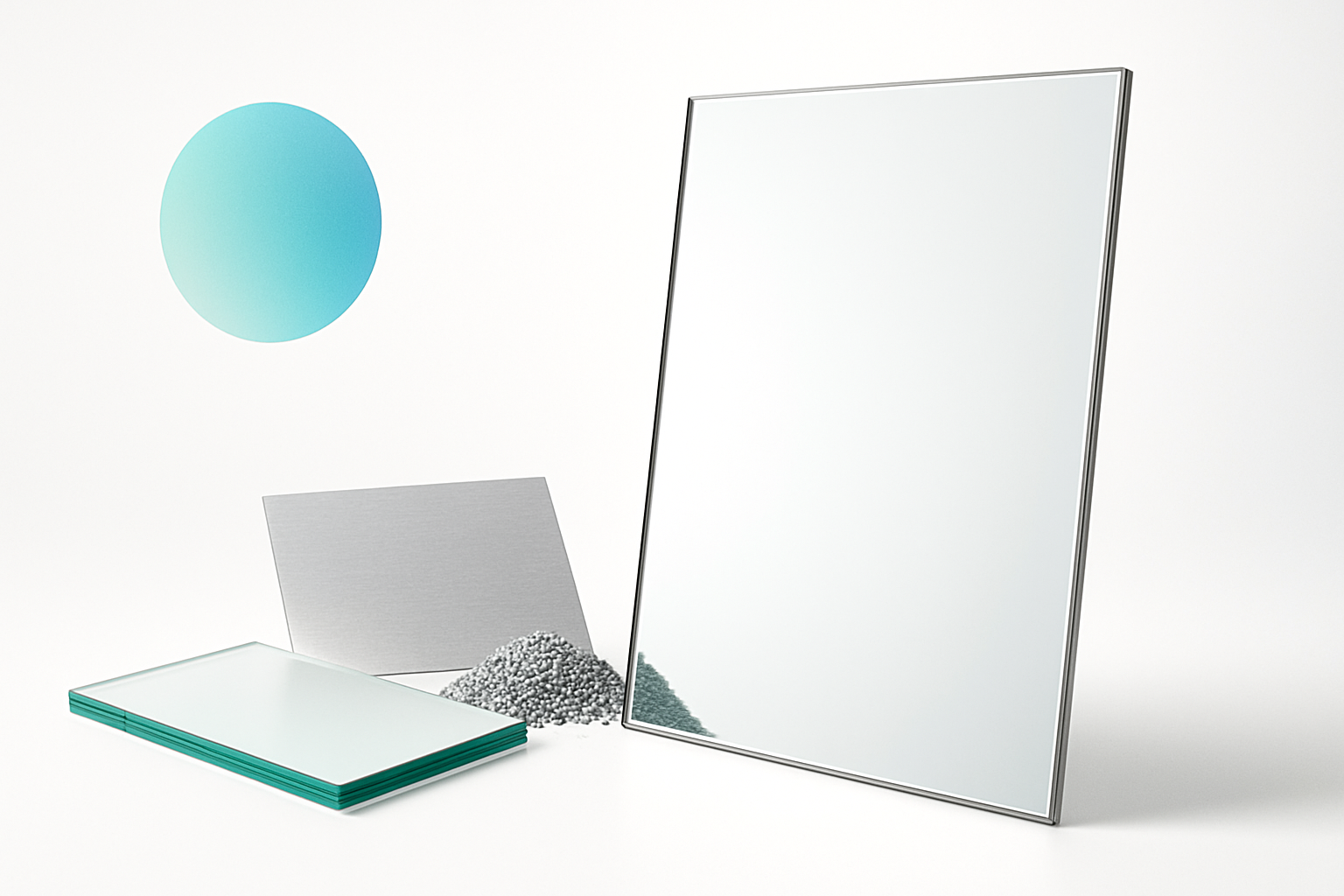
The Science Behind Your Daily Reflection
Every morning, you glance into a mirror without giving it much thought. But have you ever wondered what are mirrors made of and how they create such perfect reflections? The answer involves fascinating materials science, precise manufacturing processes, and chemistry that transforms ordinary glass into surfaces capable of showing us ourselves with remarkable clarity.
Modern mirrors are far more complex than they appear. While they might look like simple pieces of glass, they’re actually sophisticated layered structures designed to reflect nearly all the light that hits them. Understanding their composition reveals why some mirrors last decades while others develop spots and streaks over time.
The Foundation: Glass as the Starting Point
Most mirrors begin with a sheet of high-quality glass, typically made from silica sand, soda ash, and limestone. This glass serves as the transparent substrate that provides structural support and protection for the reflective layers beneath.
The glass used in mirror manufacturing must meet strict standards. It needs to be extremely flat, free from bubbles or imperfections, and have consistent thickness. Any flaws in the glass will show up as distortions in the final mirror.
Manufacturers often use float glass, created by floating molten glass on a bed of molten tin. This process produces exceptionally smooth, flat surfaces perfect for mirror production.
The Reflective Layer: Silver Takes Center Stage
The magic happens with a thin layer of silver deposited on the back of the glass. Silver reflects about 95% of visible light, making it the ideal material for creating clear, bright reflections.
The silvering process involves several chemical steps:
- Cleaning the glass surface to remove any contaminants
- Applying a sensitizing solution that helps the silver adhere
- Depositing metallic silver through chemical reduction
- Building up the silver layer to optimal thickness
This silver layer is incredibly thin – typically only a few hundred nanometers thick. Despite its thinness, it’s dense enough to reflect most light while remaining economical to produce.
Alternative Reflective Materials
While silver dominates modern mirror production, other materials serve specific purposes:
Aluminum offers excellent durability and corrosion resistance. Though it reflects slightly less light than silver (around 90%), aluminum mirrors work well in harsh environments and cost less to manufacture.
Gold appears in specialized applications like telescope mirrors. Gold’s exceptional corrosion resistance and infrared reflection properties make it valuable for scientific instruments, despite its high cost.
Protective Coatings: Keeping Your Mirror Perfect
Raw silver tarnishes quickly when exposed to air and moisture. Manufacturers apply multiple protective layers to ensure mirrors last for years without degradation.
The first protective layer is usually copper, deposited directly onto the silver. Copper bonds well with silver and provides an excellent barrier against oxidation. This copper layer typically measures 200-400 nanometers thick.
Next comes a layer of paint or specialized backing material. This final coating serves multiple purposes:
- Protection from physical damage
- Moisture barrier
- Chemical resistance
- Structural support
High-quality mirrors might include additional protective treatments, such as edge sealing to prevent moisture infiltration from the sides.
Manufacturing Process: From Glass Sheet to Finished Mirror
Creating mirrors requires precise control at every step. The process typically occurs in clean room environments to prevent contamination that could cause defects.
The glass sheets first undergo thorough cleaning with specialized detergents and rinses. Even microscopic particles or chemical residues can prevent proper silver adhesion.
Temperature and humidity control are critical during silvering. The chemical solutions work best within narrow environmental parameters, and variations can result in uneven coating or poor adhesion.
Quality control involves multiple inspections throughout production. Manufacturers check for coating uniformity, adhesion strength, and optical clarity before applying protective layers.
Different Types: What Are Mirrors Made of Across Various Applications
Not all mirrors use the same materials or construction methods. Different applications demand specific properties.
Bathroom Mirrors
Bathroom mirrors face constant humidity and temperature changes. They typically feature enhanced moisture barriers and corrosion-resistant edge treatments. Some include anti-fog coatings applied to the front surface.
Automotive Mirrors
Car mirrors must withstand vibration, temperature extremes, and weather exposure. They often use thicker glass substrates and specialized adhesives. Heated mirrors include thin electrical elements embedded in the protective backing.
Decorative Mirrors
Antique-style mirrors might use traditional mercury amalgam backing (in historical pieces) or modern materials designed to mimic aged appearances. Contemporary decorative mirrors sometimes incorporate tinted glass or colored backing materials.
Scientific and Industrial Mirrors
Precision applications require mirrors with extremely high reflectivity and minimal distortion. These might use vacuum-deposited aluminum on specially polished glass substrates, with optical coatings designed for specific wavelengths.
Quality Factors: Why Some Mirrors Outperform Others
Several factors determine mirror quality and longevity. Understanding these helps explain price differences and performance variations.
Glass quality forms the foundation. Premium mirrors use optical-grade glass with minimal internal stress and perfect flatness. Lower-grade mirrors might show subtle distortions or develop stress fractures over time.
Silver purity and thickness directly affect reflectivity and durability. High-end mirrors use purer silver applied in optimally thick layers, while budget options might skimp on silver content.
Protective coating quality determines how well mirrors resist environmental damage. Superior protective systems prevent edge corrosion and backing deterioration that cause dark spots and silvering loss.
Environmental Considerations and Sustainability
Modern mirror manufacturing increasingly focuses on environmental responsibility. Silver recovery systems capture and recycle precious metals from production waste. Some manufacturers use recycled glass for substrates, reducing raw material consumption.
Lead-free glass formulations eliminate toxic materials from the manufacturing process. Water-based protective coatings replace solvent-based alternatives, reducing volatile organic compound emissions.
At end-of-life, mirrors present recycling challenges due to their layered construction. However, specialized facilities can separate glass and recover silver for reuse in new products.
Common Problems and Their Material Causes
Understanding mirror construction helps explain common failure modes. Black spots typically result from silver corrosion where moisture penetrates the protective backing. This often occurs at edges where sealing has failed.
Hazy or cloudy areas usually indicate silver oxidation or delamination between layers. Poor initial bonding or exposure to harsh chemicals can cause these problems.
Scratches on the reflecting surface actually damage the silver layer behind the glass. Since this layer sits on the back surface, scratches appear deeper and more noticeable than damage to the front glass surface.
The Future of Mirror Technology
Emerging technologies are expanding what mirrors can do beyond simple reflection. Smart mirrors incorporate LED displays behind partially reflective coatings, creating surfaces that can show information while maintaining mirror functionality.
Nanotechnology enables new coating formulations with enhanced properties. Self-cleaning surfaces use photocatalytic materials that break down organic contaminants when exposed to light.
Advanced manufacturing techniques allow for curved mirrors with complex geometries, opening new applications in architecture and automotive design.
The next time you look into a mirror, you’ll appreciate the sophisticated materials science working behind that perfect reflection. From carefully formulated glass to precisely deposited silver layers and protective coatings, mirrors represent a remarkable combination of chemistry, physics, and manufacturing precision that we encounter every single day.
