

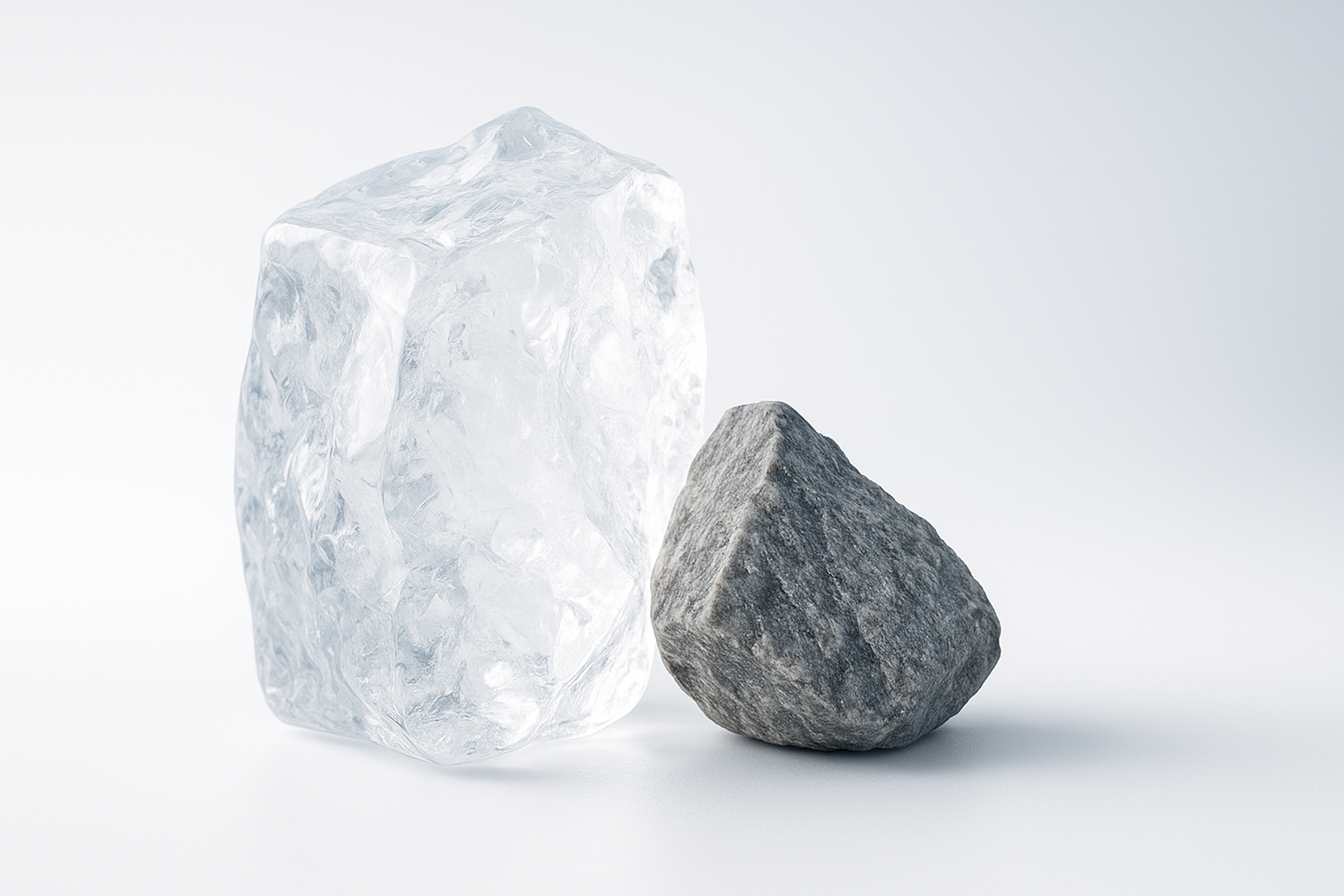
When Water Freezes, Does It Transform Into Rock?
The question “is ice a rock?” might sound unusual at first, but it touches on fundamental concepts in geology and materials science that scientists have debated for decades. While most people think of rocks as hard, permanent fixtures in the landscape and ice as temporary frozen water, the scientific reality is far more nuanced.
Ice actually meets many criteria that geologists use to define rocks and minerals. It forms through natural processes, has a crystalline structure, and can even be found in geological formations. However, the answer depends entirely on how we define “rock” and which scientific framework we’re using.
Understanding this classification helps us appreciate how materials behave in different environments, from Earth’s polar regions to the icy moons of Jupiter and Saturn, where water ice plays a role similar to silicate rocks on our planet.
The Scientific Definition of Rock
Geologists define rocks as naturally occurring solid materials composed of one or more minerals. These materials form through various processes including cooling of molten material, compression of sediments, or transformation under heat and pressure.
Traditional rocks fall into three main categories:
- Igneous rocks – formed from cooling magma or lava
- Sedimentary rocks – created from compressed layers of material
- Metamorphic rocks – transformed by heat and pressure
The key characteristics that define rocks include natural formation, solid state under normal surface conditions, and mineral composition. When we examine ice against these criteria, some interesting patterns emerge.
Ice as a Mineral: The Foundation for Rock Status
Before determining whether ice qualifies as a rock, we need to establish if it counts as a mineral. The International Mineralogical Association recognizes five criteria for mineral classification:
- Naturally occurring
- Inorganic
- Solid
- Definite chemical composition
- Ordered internal structure
Ice meets all these requirements. It occurs naturally in countless environments, maintains an inorganic composition of H2O, exists as a solid below 0°C (32°F), and forms hexagonal crystals with a highly ordered molecular structure.
This classification means ice is officially recognized as a mineral, which provides the foundation for considering its potential rock status. Many accepted rocks consist of single minerals, so ice’s mineral classification removes one major barrier to rock designation.
Where Is Ice a Rock? Environmental Context Matters
The classification of ice becomes clearer when we consider environmental context. In many polar and high-altitude regions, ice behaves remarkably similarly to traditional rocks.
Glacial Ice Formation
Glacial ice forms through processes that mirror sedimentary rock formation. Snow accumulates in layers, compacts under pressure, and gradually transforms into dense, crystalline ice. This process, called diagenesis, is identical to how many sedimentary rocks form from loose sediments.
Ancient glacial ice can be hundreds of thousands of years old, rivaling the age of many rock formations. These ice masses shape landscapes, carve valleys, and transport enormous amounts of material—all functions typically associated with rocks.
Permafrost and Frozen Ground
In Arctic regions, permanently frozen ground creates ice-rich layers that function as bedrock. These formations support buildings, influence drainage patterns, and create geological features that persist for millennia.
Engineers and geologists working in these environments often treat ice-rich permafrost as rock for practical purposes, designing foundations and excavation plans based on ice’s mechanical properties rather than traditional soil characteristics.
Ice on Other Worlds: Clearly Rock-Like Behavior
Perhaps the strongest argument for ice’s rock status comes from planetary geology. On many moons and planets in our solar system, water ice serves the exact function that silicate rocks serve on Earth.
Jupiter’s moon Europa has an ice crust estimated at 15-25 kilometers thick. This shell experiences tectonic activity, forms mountain ranges, and undergoes the same geological processes we observe in Earth’s rock-based crust.
Saturn’s moon Enceladus shoots geysers of water through cracks in its icy surface, demonstrating volcanic-like activity where ice plays the role typically filled by molten rock. These examples show that ice can absolutely function as the primary geological material in appropriate environments.
The Temperature Question: Why Context Defines Everything
The main argument against classifying ice as rock centers on temperature stability. Critics point out that ice melts easily under conditions where traditional rocks remain solid.
However, this perspective reflects Earth-centric thinking. On our planet, surface temperatures generally hover near ice’s melting point, making it seem temporary and unstable. But temperature stability is relative to environment.
Granite melts at approximately 1,260°C (2,300°F), yet we don’t question its rock status simply because it would be liquid in hotter environments. Similarly, ice remains perfectly stable and permanent in environments below its melting point.
In Antarctica, some ice formations have remained solid for over 400,000 years. This longevity rivals many surface rock formations in more temperate climates, where erosion and weathering constantly reshape the landscape.
Practical Applications: When Ice Functions as Rock
Understanding ice’s rock-like properties has practical implications across multiple fields:
Construction and Engineering: Arctic construction projects treat ice as a load-bearing geological material, calculating foundation requirements based on ice’s mechanical properties rather than assuming temporary support.
Mining Operations: Some mining operations in polar regions must excavate through massive ice formations using techniques developed for hard rock mining, including blasting and mechanical crushing.
Geological Surveys: Polar researchers map ice formations using the same techniques applied to rock formations, including core sampling, structural analysis, and stratigraphic interpretation.
Scientific Consensus: The Emerging Perspective
Modern geological thinking increasingly recognizes ice’s rock status in appropriate contexts. The key insight is that material classification should reflect function and environment rather than familiar Earth-surface conditions alone.
Several major geology textbooks now include ice in discussions of Earth materials, particularly when covering glacial geology and planetary science. This shift reflects growing recognition that our definitions should accommodate the full range of environments where geological processes occur.
Research institutions studying polar regions routinely apply rock mechanics principles to ice formations, finding that the same mathematical models and physical laws govern both materials’ behavior under stress.
Why This Classification Matters
Determining whether ice qualifies as rock isn’t merely academic—it influences how we understand planetary formation, climate history, and even the potential for life on other worlds.
When we recognize ice as rock in appropriate contexts, we can apply centuries of geological knowledge to understand icy environments. This perspective helps scientists interpret features on Mars, predict behavior of Earth’s ice sheets, and design missions to explore the outer solar system.
The question “is ice a rock?” ultimately challenges us to think more broadly about materials and their roles in shaping worlds. While ice might not fit traditional rock definitions based on Earth-surface experience, it clearly functions as the primary geological material in many environments throughout our solar system.
Whether we call it rock or not, ice deserves recognition as a legitimate geological material that shapes landscapes, preserves history, and creates the foundation for entire worlds. The classification debate reflects our evolving understanding of how materials behave across the diverse environments found throughout the universe.
