

Understanding the Fundamental Split in SEO Strategy
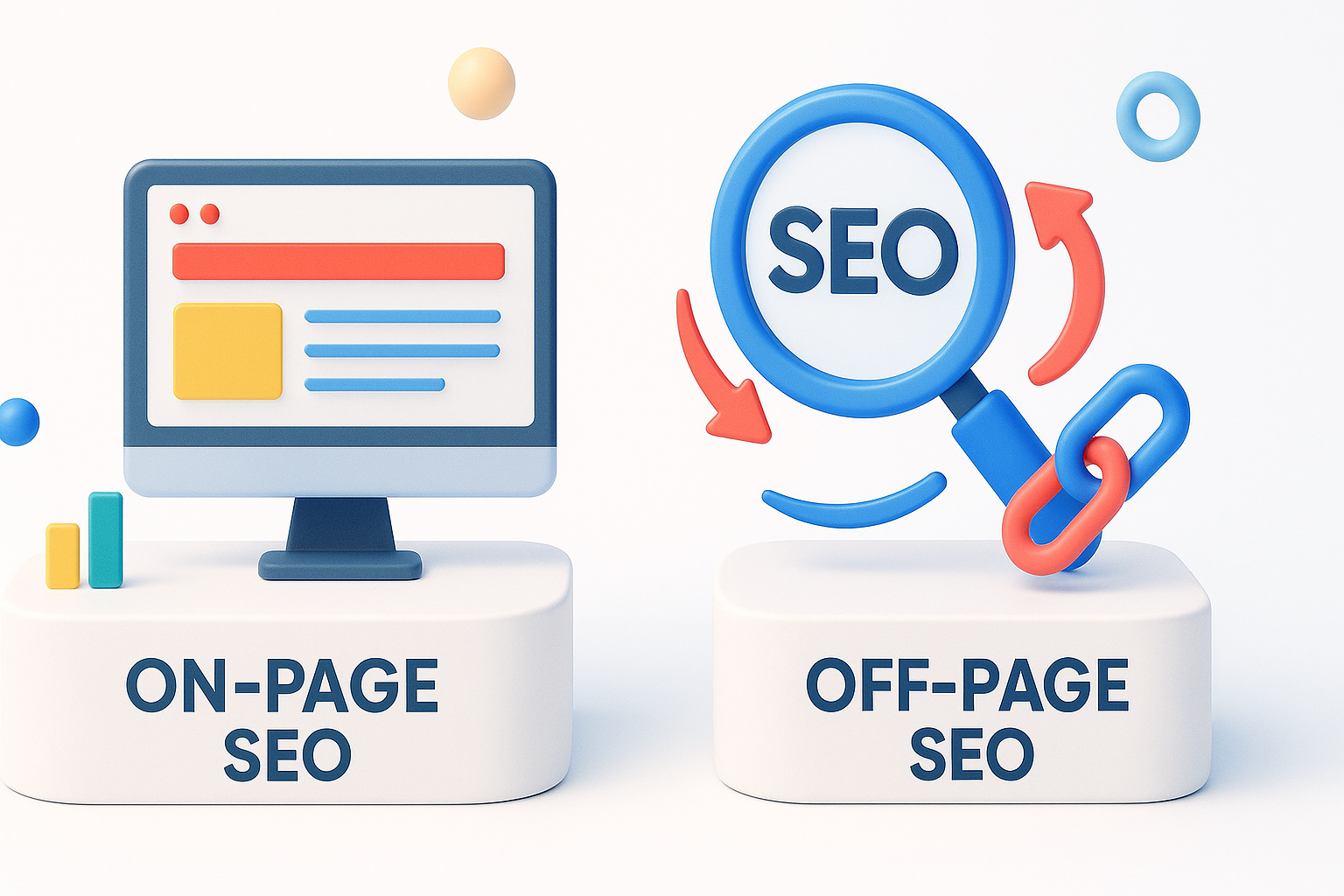
Search engine optimization splits into two distinct territories that work together to boost your website’s visibility. The difference between on page and off page SEO lies in where the optimization happens: directly on your website versus external signals from across the internet.
Think of on-page SEO as perfecting your house before guests arrive, while off-page SEO is about building your reputation in the neighborhood. Both approaches are essential, but they require completely different strategies and mindsets.
Most website owners struggle because they focus heavily on one area while neglecting the other. Understanding how these two pillars complement each other will transform how you approach search rankings and organic traffic growth.
On-Page SEO: Controlling Your Digital Foundation
On-page optimization encompasses every element you can directly control on your website. This includes content quality, technical performance, user experience, and how well you communicate your page’s purpose to search engines.
Your content serves as the cornerstone of on-page efforts. Search engines need to understand what your pages offer and whether they satisfy user queries better than competing results.
Core On-Page Elements That Drive Rankings
Content optimization goes far beyond keyword placement. You need comprehensive coverage of topics, natural language that answers real questions, and formatting that makes information digestible.
Title tags and meta descriptions act as your storefront window in search results. They need to accurately represent your content while compelling users to click through to your site.
Header structure helps both users and search engines navigate your content hierarchy. Proper H1, H2, and H3 usage creates logical flow and emphasizes important concepts.
Internal linking distributes authority throughout your site while helping users discover related content. Strategic linking patterns signal content relationships and site architecture to search engines.
Technical optimization ensures search engines can crawl, index, and understand your pages efficiently. This includes site speed, mobile responsiveness, structured data, and clean URL structures.
Advanced On-Page Strategies
Page loading speed directly impacts both user experience and search rankings. Compress images, minimize code, and leverage browser caching to create lightning-fast experiences.
Schema markup provides additional context about your content’s meaning and purpose. Rich snippets in search results often come from properly implemented structured data.
Content freshness signals relevance and accuracy to search engines. Regular updates, new sections, and current information keep pages competitive in search results.
Off-Page SEO: Building External Authority and Trust
Off-page optimization focuses on signals from external websites and platforms that indicate your site’s credibility, relevance, and authority within your industry or niche.
These external signals operate like votes of confidence. When reputable websites link to your content or mention your brand, search engines interpret this as validation of your expertise and trustworthiness.
Link Building as the Primary Off-Page Signal
Backlinks from other websites remain the strongest off-page ranking factor. However, link quality matters infinitely more than quantity in modern SEO.
Editorial links occur naturally when other content creators find your material valuable enough to reference. These carry the most weight because they represent genuine endorsements.
Guest posting allows you to contribute valuable content to relevant websites while earning contextual links back to your site. Focus on publications your target audience actually reads.
Resource page inclusion happens when websites list your content as a helpful reference for their audience. These links often come from highly authoritative educational or industry sites.
Broken link building involves finding dead links on relevant websites and suggesting your content as a replacement. This provides value to the linking site while earning you a quality backlink.
Beyond Link Building: Comprehensive Off-Page Strategies
Social media engagement doesn’t directly impact rankings, but it amplifies content reach and increases the likelihood of earning natural links and mentions.
Brand mentions without links still contribute to authority signals. Search engines track when websites and social platforms discuss your brand, products, or key personnel.
Local citations become crucial for businesses serving specific geographic areas. Consistent business information across directories and local platforms builds location-based authority.
Industry partnerships and collaborations create natural opportunities for high-quality mentions and links from relevant, authoritative sources.
Key Differences in Approach and Timeline
| Aspect | On-Page SEO | Off-Page SEO |
| Control Level | Complete control over implementation | Limited control, relies on external factors |
| Results Timeline | Faster results, often within weeks | Slower results, typically months to years |
| Primary Focus | Content quality and technical performance | Authority building and reputation management |
| Cost Structure | Lower cost, mainly time investment | Higher cost, often requires outreach and networking |
| Measurement | Direct tracking through analytics | Harder to measure, requires specialized tools |
How On-Page and Off-Page SEO Work Together
Exceptional on-page optimization creates the foundation that makes off-page efforts possible. No amount of external linking can compensate for poor content or terrible user experience.
Strong off-page authority amplifies the impact of on-page improvements. High-authority sites often rank well even with moderate on-page optimization, while low-authority sites struggle despite perfect technical implementation.
Content that answers real questions and provides genuine value naturally attracts links and social shares. This creates a virtuous cycle where great on-page SEO fuels off-page success.
Technical problems can sabotage off-page gains. If your site loads slowly or breaks on mobile devices, even high-quality backlinks won’t deliver their full ranking potential.
Common Mistakes That Undermine SEO Success
Many website owners obsess over perfect on-page optimization while completely ignoring relationship building and outreach. This creates technically sound websites that lack the authority to compete in competitive markets.
Conversely, some focus exclusively on acquiring links while publishing thin, unhelpful content. Search engines have become sophisticated at detecting this mismatch between external signals and actual value.
Keyword stuffing represents a fundamental misunderstanding of modern on-page optimization. Natural, helpful content outperforms artificially optimized text in both user engagement and search rankings.
Buying low-quality links or participating in link schemes can trigger search engine penalties that take months or years to recover from. Quality always trumps quantity in off-page SEO.
Building Your Integrated SEO Strategy
Start with solid on-page fundamentals before investing heavily in off-page efforts. Ensure your content provides real value, your site performs well technically, and your user experience encourages engagement.
Develop content worth linking to naturally. In-depth guides, original research, useful tools, and unique insights create link magnets that support long-term off-page success.
Build genuine relationships within your industry. Authentic connections lead to natural linking opportunities, collaboration possibilities, and increased brand visibility.
Monitor both on-page performance metrics and off-page signals regularly. Use tools to track rankings, backlink acquisition, brand mentions, and technical health simultaneously.
The Strategic Balance That Drives Long-Term Success
Understanding the difference between on page and off page SEO enables you to allocate resources effectively and avoid common pitfalls that waste time and money. Neither approach works optimally in isolation.
Successful SEO campaigns integrate both elements strategically. Perfect on-page optimization provides the foundation, while consistent off-page efforts build the authority needed to compete in valuable search results.
Focus on creating genuine value for your audience through superior content and user experience. This approach naturally generates the external signals that search engines interpret as indicators of quality and relevance.
