

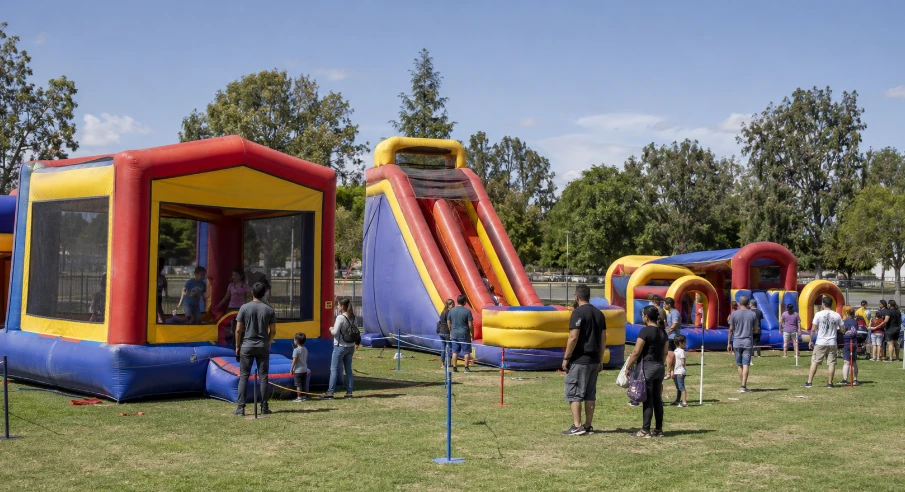
Commercial inflatables can be valuable assets for party rental companies, event organizers, schools, resorts and family entertainment venues. A well-chosen unit can serve many events, appeal to different customer groups and help a business expand its rental packages.
However, selecting the right equipment involves more than comparing colors, themes and prices. Buyers also need to consider construction quality, target users, operating capacity, installation space, transportation requirements and after-sales support.
This guide covers the most important factors to review before purchasing commercial inflatable equipment.
Commercial vs. Residential Inflatables
The first step is confirming that the equipment is designed for repeated commercial operation.
Residential inflatables are generally intended for occasional backyard use. They are often smaller and lighter, with materials selected mainly for portability and affordability. While suitable for private family entertainment, they may not be designed for frequent transportation, setup and use at public events.
Commercial inflatables are made for more demanding applications. They typically feature heavier PVC-coated material, reinforced stress areas, stronger stitching and more substantial anchoring systems.
Buyers should request material specifications, construction details, operating instructions and warranty terms rather than relying only on a product description that says “commercial grade.”
Choose the Right Type of Attraction
Different inflatable attractions serve different audiences and event formats. The right choice depends on the customers, venues and events a business normally serves.
Bounce Houses
Bounce houses are widely recognized and suitable for birthday parties, school events and community celebrations. Their straightforward operation makes them a practical starting point for a new rental inventory.
When comparing models, consider the intended age group, internal play area, entrance design, visibility and user capacity. A themed design may attract specific customers, while a more versatile color scheme can suit a wider variety of events.
Inflatable Combos
Combo units combine activities such as bouncing, climbing and sliding in one structure. They can provide more play value without requiring several separate inflatables.
Combos are especially useful when customers want a complete attraction but have limited venue space. Buyers should confirm whether a unit can operate wet, dry or in both formats and whether removable pools or landing sections are included.
Inflatable Slides
Inflatable slides create strong visual impact and are often popular at festivals, summer events and outdoor gatherings. They are available in dry and water configurations, with single or multiple lanes.
Overall height is only one consideration. Buyers should also examine the platform height, climbing route, lane width, landing design and required operating area. Larger slides may attract more attention, but they can also require additional staff, power, setup time and transportation capacity.
Obstacle Courses
Obstacle courses are designed around continuous movement. Participants may crawl through tunnels, climb barriers and race toward a slide or separate exit.
They are particularly suitable for schools, corporate events and high-traffic festivals. Modular obstacle courses offer additional flexibility because individual sections can sometimes operate independently at smaller events or connect to form a longer course.
Interactive Games
Inflatable basketball challenges, sports games and competitive activities can diversify a rental inventory. Their shorter playing rounds may help distribute participants more evenly across a venue.
These games can also be useful for corporate functions and school programs where organizers want several different activities rather than one large attraction.
Match the Product to the Target Customer
An inflatable that performs well for one rental business may not be suitable for another. Before purchasing, identify the customers and events the equipment is expected to serve.
Consider the following questions:
- Are most participants children, teenagers, adults or mixed-age groups?
- Are events normally held in backyards, schools, parks or commercial venues?
- Do customers prefer themed products or neutral designs?
- Is local demand stronger for wet or dry attractions?
- Are bookings mainly private parties or high-capacity public events?
- Are there common venue restrictions involving height, power or access?
- Does the local climate support outdoor operation throughout the year?
A company serving residential parties may benefit from compact bounce houses and combo units. A business focused on schools and festivals may achieve better results with obstacle courses, interactive games and high-capacity slides.
Purchasing according to genuine customer demand is more reliable than selecting products only because they look impressive.
Evaluate Material and Construction Quality
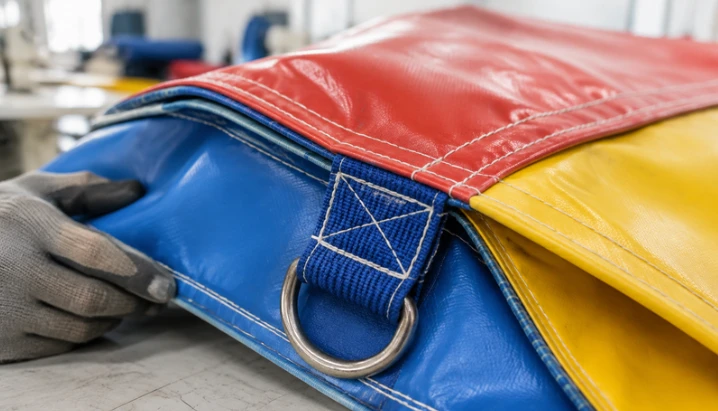
Commercial inflatables experience repeated inflation, deflation, folding, transportation and user activity. Construction quality therefore affects both service life and maintenance costs.
Ask the supplier about the type, weight and thickness of the PVC material. Where required, buyers should also request relevant information regarding fire-retardant materials and other applicable testing.
Material specifications should not be evaluated in isolation. Heavy PVC combined with weak seams or poorly reinforced stress points can still lead to premature damage.
Important construction areas include:
- Major seams and internal structures
- Entrances and exits
- Climbing sections and steps
- Slide lanes and landing areas
- Anchor points
- High-contact and high-wear surfaces
Consistent stitching and suitable reinforcement are particularly important in these areas. Removable slide covers and replaceable wear surfaces may also make maintenance easier on frequently used equipment.
For large slides, obstacle courses and custom products, buyers can request production images or technical drawings to better understand the internal and external construction.
Check the Complete Setup Space
The dimensions of the inflatable are only the beginning of space planning.
Additional space may be required for:
- Anchoring points
- Blowers and inflation tubes
- Electrical cables
- Attendant positions
- Participant queues
- Entrances and exits
- Parents and spectators
- Separation from buildings and other obstacles
A product listed as 30 feet long will not necessarily fit comfortably in a space that is exactly 30 feet long. Buyers should request a setup diagram showing the inflatable, anchor locations, blower positions and recommended clearances.
Indoor installations require further checks. Ceiling height, entrance doors, hallways, elevators and loading areas may determine whether the packed product can enter the building and operate in the intended location.
Consider Capacity and Participant Flow
Capacity should not be estimated from appearance alone. Buyers should request recommended user limits and operating guidance from the manufacturer.
The practical capacity of an attraction can depend on participant age, height or weight, as well as the type of activity. A bounce house operating in timed sessions will handle visitors differently from an obstacle course with a continuous one-way route.
Entrance and exit positions also affect event flow. Separate entry and exit points may reduce congestion and make supervision easier, particularly at busy public events.
When comparing commercial inflatables, buyers should consider how each attraction will fit into their usual venue sizes, staffing arrangements and customer mix—not simply its dimensions or appearance.
A balanced inventory usually includes products with different operating patterns. If every attraction has a slow turnover rate, queues may develop across the entire event. Combining larger attractions with shorter interactive games can help distribute visitors more effectively.
Review Blower, Power and Anchoring Requirements
Most continuous-air commercial inflatables require one or more blowers throughout operation.
Before purchasing, confirm:
- The number of blowers required
- Blower power ratings
- Voltage and plug type
- Whether blowers are included
- The length and position of inflation tubes
- Whether separate electrical circuits may be necessary
Voltage and electrical requirements vary by destination country. Blowers should be suitable for the intended market and supported by the appropriate documentation.
The anchoring arrangement is equally important. Buyers should confirm the number and location of anchor points, recommended stake specifications and installation requirements for different ground surfaces.
If a business regularly works on concrete, asphalt or indoor flooring, it may need an appropriate ballast arrangement and additional transportation capacity. The weight of an inflatable alone does not replace the anchoring system specified by the manufacturer.
Confirm Standards and Documentation
Requirements for inflatable amusement equipment vary by country, state, province and local authority. Buyers should determine which documents are required in their operating area before placing an order.
Depending on the market and type of equipment, relevant documents may include:
- Material test reports
- Manufacturer declarations
- Operating instructions
- Setup and anchoring guidance
- Inspection forms
- Maintenance recommendations
- Product identification or serial numbers
- Blower documentation
- Applicable safety-standard information
A supplier should clearly explain which documents are included with the product. Buyers should not assume that one certificate automatically satisfies every local permit, insurance or inspection requirement.
For commercial operation, consulting the relevant authority, inspector or insurance provider before finalizing a major purchase can prevent expensive complications later.
Plan for Transportation and Storage
An inflatable may fit the event site but still be difficult to transport and handle.
Before purchasing, ask for the packed dimensions, total weight, number of packages and recommended handling method. Larger products may require a trolley, winch, loading ramp or several trained workers.
Water slides and obstacle courses can be particularly difficult to pack if they are not completely dry. Equipment should be cleaned and dried before storage, then kept away from moisture, pests, sharp objects and excessive heat.
Transportation, handling and storage expenses should be included in the purchase decision because they contribute to the real operating cost of the equipment.
Review Customization and After-Sales Support
Custom colors, printed graphics, removable banners and branded elements can help a product stand out. However, customization should support the intended business model.
Highly specific artwork may suit a permanent venue or corporate customer but limit demand in the general rental market. Neutral designs and removable banners may provide greater flexibility.
Before approving a custom product, confirm:
- Overall dimensions
- Color placement
- Artwork and logo positions
- Entrance and exit locations
- Slide and climbing directions
- Removable components
- Final production drawings
Buyers should also review the supplier’s warranty and after-sales support. Ask whether repair materials are included, whether replacement components are available and what evidence is required for a warranty claim.
Normal wear, improper operation, weather damage and manufacturing defects may be treated differently under the warranty, so the complete terms should be reviewed before purchase.
Suppliers such as EastJump can also help buyers compare product types, customization options and practical installation requirements before production begins.
Calculate the Total Cost of Ownership
The lowest purchase price does not always represent the best long-term value.
The complete cost may include:
- Product price
- Custom design charges
- Blowers and accessories
- Shipping
- Import duties and taxes
- Inspection or permit costs
- Anchoring or ballast equipment
- Handling equipment
- Storage
- Cleaning and maintenance
- Insurance
- Labor
A more durable product may justify a higher initial cost if it reduces repair frequency and supports repeated bookings. On the other hand, a very large or complicated inflatable may increase staffing, transportation and storage costs.
The best value is the product that fits the company’s customers, venues and operating resources—not simply the product with the lowest quotation.
Final Buyer Checklist
Before placing an order, confirm that:
- The equipment is designed for commercial use
- The dimensions fit typical event venues
- The packed weight and size are manageable
- The design suits the target customer
- User and operating guidance is available
- Material and construction details have been reviewed
- Anchoring requirements are clearly documented
- Suitable blowers are included or specified
- Voltage matches the destination market
- Required documents have been confirmed
- Colors and artwork have been approved
- Warranty terms are understood
- Shipping and total landed costs are known
- After-sales support is available
Any important specification that remains unclear should be confirmed in writing before production begins.
Conclusion
Purchasing commercial inflatables requires a balance between visual appeal, construction quality, practical operation and long-term value.
The right attraction should suit the target audience, fit common event venues, support efficient participant flow and remain manageable for the rental team. Materials, stitching, anchoring, blowers, documentation, transportation and warranty support all deserve careful review.
A structured buying process helps event and rental businesses avoid unsuitable equipment and build an inventory that can serve different customers over time. Instead of choosing only by appearance or price, buyers should consider how each inflatable will perform throughout its complete working life—from delivery and setup to operation, maintenance and storage.
