

The Strange Genius Behind History’s Most Bizarre Inventions
Some of the most important things ever created looked completely ridiculous at first. The telephone was called a toy. The automobile was dismissed as a passing fad. And somewhere in between the genuinely transformative and the totally absurd sits a category of human creativity that deserves its own spotlight — the weird invention.
These aren’t just novelty gags or failed products. Many of them represent real problems someone was trying to solve, just with solutions that make you tilt your head and ask, “Wait… seriously?” Others were pure eccentric genius — ideas so far outside normal thinking that they looped back around to being fascinating.
What follows is a look at some of the strangest, most creative, and occasionally brilliant odd inventions ever produced — and what they actually tell us about human ingenuity.
Weird Inventions That Actually Worked (Sort Of)
Not every bizarre invention flopped. Some strange ideas found their audience, solved real problems in unexpected ways, or became cultural touchstones despite — or because of — how odd they were.
The Pet Rock
Gary Dahl sold plain rocks — literally rocks from a construction supplier — packaged in cardboard boxes with air holes and a care manual. In 1975, he sold over 1.5 million of them at $3.95 each and made roughly $15 million in six months. The pet rock wasn’t solving a practical problem. It was solving a cultural one: people wanted something low-maintenance and absurd to laugh about. Sometimes weird is the whole point.
Baconnaise
A bacon-flavored mayonnaise spread that’s also kosher, meaning it contains no actual bacon. The product exists in a philosophical gray area that somehow also tastes fine. It was a hit at state fairs and novelty food markets, proving that flavor combinations people assume are jokes can find loyal followings.
The Snuggie
A blanket with sleeves sounds like a punchline. It sold over 20 million units. The Snuggie became a cultural phenomenon partly because of its campy infomercials and partly because — let’s be honest — wearing a blanket while keeping your arms free is genuinely practical. The product was weird. The idea wasn’t.
Historical Oddities That Tried to Solve Real Problems
Go back through patent records and you’ll find a treasure trove of peculiar problem-solving. Some of these inventions were serious attempts at real solutions — they just didn’t quite land.
The Baby Cage (1922)
Urban apartment dwellers in the early 20th century worried their children weren’t getting enough fresh air and sunlight. Someone’s solution? A wire cage that attached to the outside of a high-rise window, allowing infants to nap in open air — several stories above the street. It was patented, sold, and used. By today’s standards, it’s terrifying. At the time, it seemed practical.
Dimple Maker (1936)
Dimples were considered beautiful, and naturally having them was a genetic lottery. An inventor named Isabella Gilbert designed a spring-loaded device that pressed small knobs into your cheeks to create artificial dimples. It was worn like a facemask and did not work as intended. It did, however, leave marks.
Isolator Helmet (1925)
Hugo Gernsback — the same man who founded science fiction publishing — invented a helmet designed to help people concentrate. It cut off all outside sound and limited vision to a tiny slit, while pumping in pure oxygen. Workers were meant to wear it at their desks for maximum focus. It looked like deep-sea diving equipment crossed with a sensory deprivation tank.
Gernsback’s logic wasn’t entirely wrong. Distraction-free environments do improve focus. He just took the concept to a deeply uncomfortable extreme.
Modern Weird Inventions That Are Very Real
Strange inventions didn’t stop in the 20th century. If anything, the internet and crowdfunding platforms like Kickstarter have made it easier than ever to bring bizarre ideas to market — and occasionally find an audience for them.
- The Ostrich Pillow: A thick, padded hood designed to let you nap anywhere by blocking out light and sound. You wear it over your entire head. It raised over $190,000 on Kickstarter.
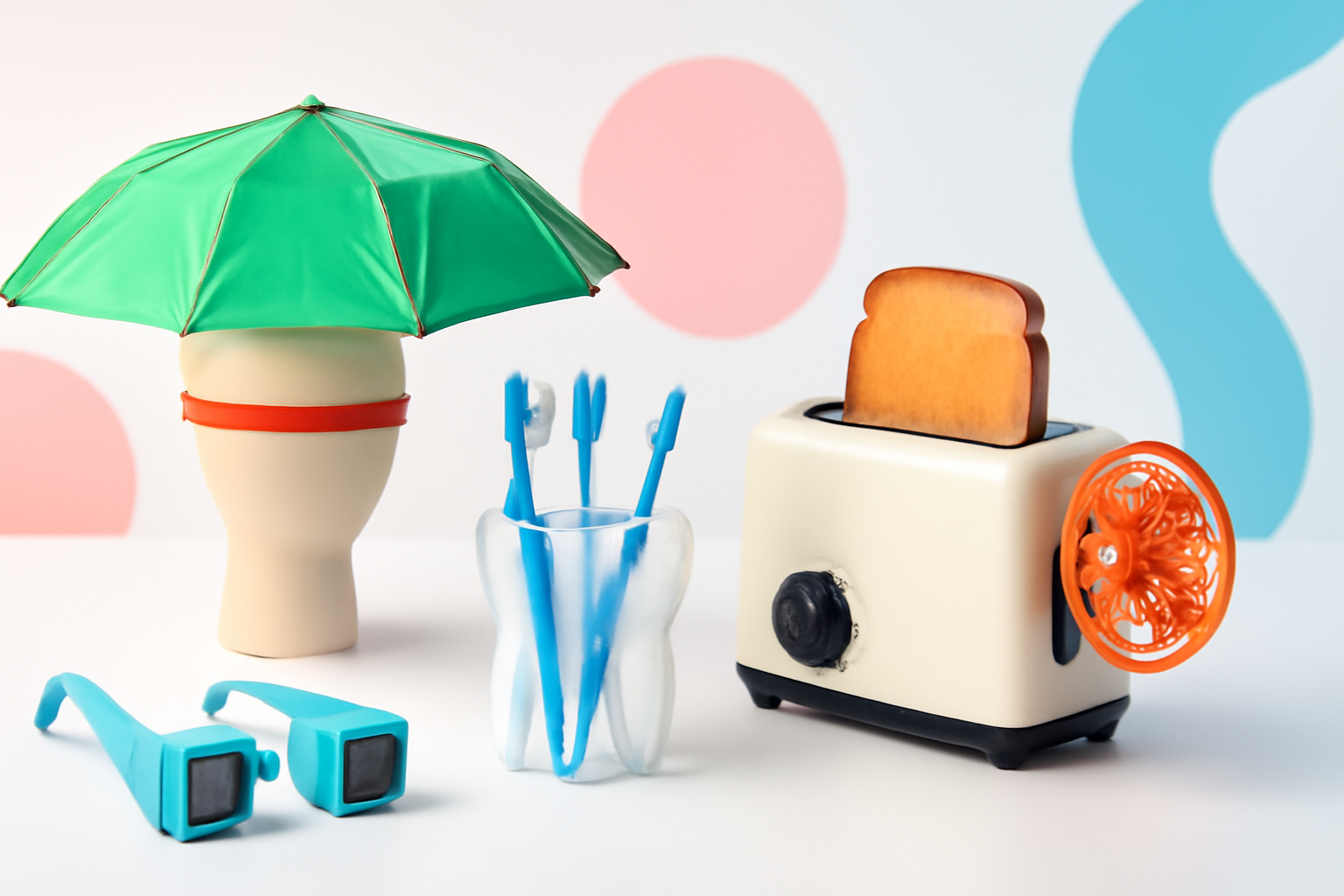
- Umbrella Shoes: Tiny umbrellas attached to the toes of your shoes to keep them dry in light rain. They do not keep the rest of your foot dry.
- Butter Stick: A glue-stick-style applicator filled with butter, designed for easy toast application. It’s exactly as impractical as it sounds and exactly as beloved by the internet.
- The Pizza Scissors Spatula: A combined spatula and scissors hybrid for cutting and serving pizza simultaneously. This one is actually kind of brilliant.
- Selfie Toaster: A toaster that burns your face onto a slice of bread every morning. Yes, this exists. Yes, people bought it.
What Makes Something a “Weird” Invention?
It’s worth pausing on this. The line between “weird” and “innovative” is often just timing, execution, or cultural context. Things that seem strange usually fall into one of these categories:
| Type | Description | Example |
| Ahead of its time | Correct idea, wrong era | Early electric cars, video calls in the 1960s |
| Solving a non-problem | Real product, imaginary need | Butter Stick, Pet Rock |
| Right problem, wild solution | Genuine issue, extreme response | Baby Cage, Isolator Helmet |
| Pure novelty | Exists to be fun or funny | Selfie Toaster, novelty gag products |
| Accidental genius | Weird concept that actually works | Snuggie, Post-it Notes (originally a failed adhesive) |
Post-it Notes are a perfect example of that last category. The adhesive Spencer Silver developed at 3M in 1968 was considered a failure because it wasn’t strong enough. It sat unused for years until a colleague realized its light-stick, easy-peel quality was the entire point. A “failed” weird invention became one of the best-selling office products in history.
The Psychology of Odd Inventions
There’s something deeply human about creating something nobody asked for. Inventors of strange products often share a particular kind of thinking — they see problems where others see normalcy, and they take solutions further than most people would dare.
Psychologists call this “divergent thinking” — the ability to generate many possible solutions to a problem rather than converging on the obvious one. It’s the same cognitive trait behind artistic creativity, but pointed at engineering and product design.
“The secret to creativity is knowing how to hide your sources.” — Albert Einstein
Many inventors of quirky products aren’t trying to be weird. They’re genuinely convinced their idea works. That conviction — sometimes misplaced, occasionally visionary — is what separates a person who thinks “what if I added sleeves to a blanket?” from someone who actually goes and makes 20 million of them.
Where Strange Ideas Come From
Most eccentric inventions follow a surprisingly recognizable pattern. They usually start with:
- A small personal frustration — something the inventor finds annoying in daily life
- A refusal to accept “that’s just how it is” — a mindset that treats inconveniences as solvable
- A solution that ignores social norms — because normal solutions already exist; the weird inventor isn’t interested in those
- Overcommitment to the concept — prototype built, patent filed, product launched before anyone can say “wait, have you thought this through?”
This pattern shows up from ancient Rome — where lead-lined food vessels were a “clever” preservation method — all the way to Silicon Valley, where “disruption” sometimes means reinventing things that already worked fine. Not every weird invention is brilliant. But the thinking process behind them often is.
Inventions That Prove “Weird” Is Just Perspective
Consider how strange these now-normal things would have sounded in their early days:
- A machine that lets you speak to someone miles away through a wire (telephone)
- A box that shows moving pictures of people who aren’t there (television)
- A network connecting every computer on Earth so strangers can share cat photos (the internet)
- Shoes with air bubbles in the sole to cushion your feet (Nike Air)
Every generation has its “that’s ridiculous” technology. Ours will look equally absurd to people a hundred years from now. Augmented reality glasses, wearable health monitors, AI assistants — these are the current candidates. Future historians might group them alongside the isolator helmet and the baby cage as “weird things people actually believed in.”
Finding the Line Between Quirky and Genius
The honest truth is that no one really knows which weird inventions will matter until much later. The pet rock mattered culturally. The Snuggie mattered commercially. Post-it Notes mattered practically. None of them would have survived a committee review or a focus group.
That’s the thing about strange inventions — they tend to bypass conventional gatekeeping because conventional gatekeeping would reject them. They get made because one stubborn, imaginative person refused to accept that only “normal” ideas deserve to exist.
Weird inventions, at their core, are proof that human creativity doesn’t follow a straight line. They zigzag, double back, and occasionally fall off a cliff — but sometimes they arrive somewhere genuinely new. And that willingness to look a little foolish in pursuit of something nobody else imagined might be the most human thing of all.
