

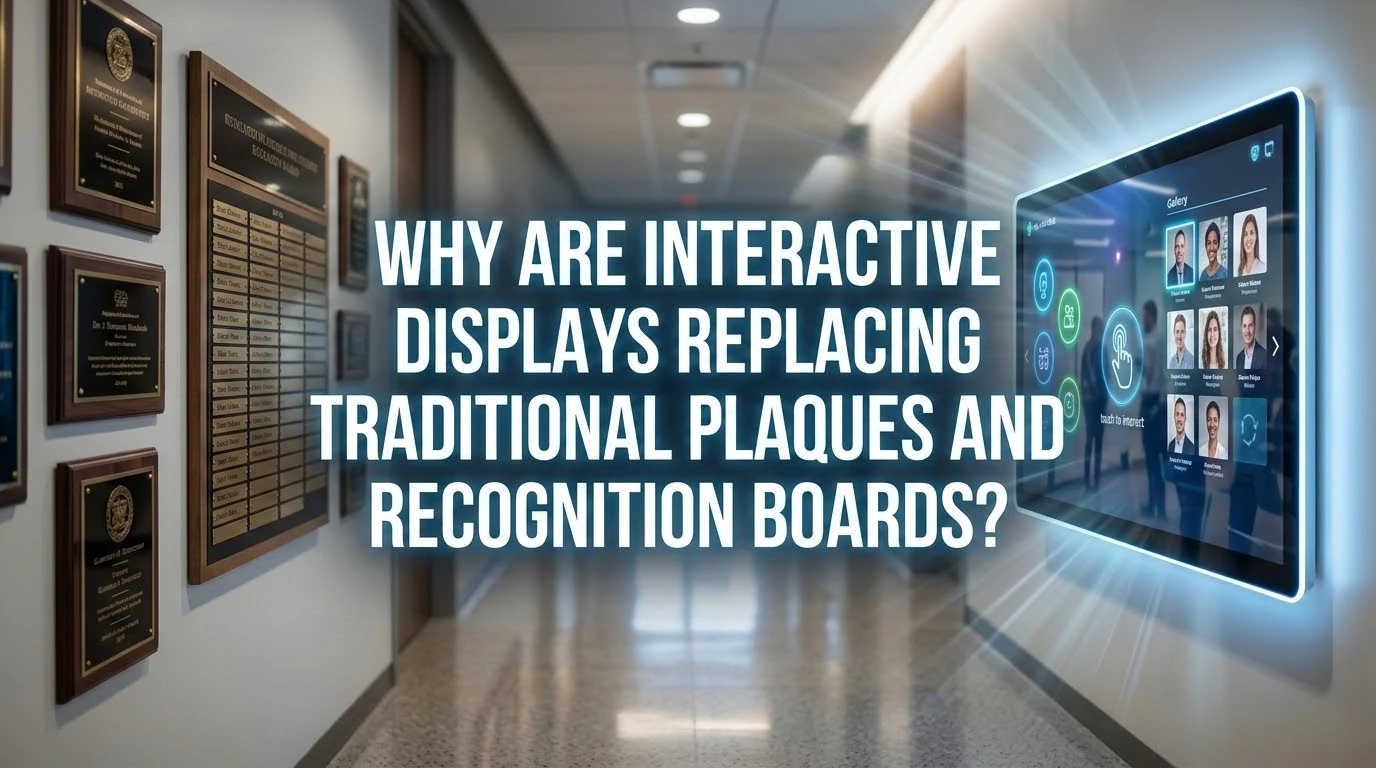
Step inside any high school constructed prior to 2010, and you’re bound to see the same scene, rows of engraved plaques lining hallways, faded trophy cases with handwritten labels and laminated class photos curling at the corners. This was the way that schools honored their history for decades. It worked until it didn’t.
Today, those plaques are being quietly removed from the walls in schools throughout the country and replaced with something much different. It’s coming at a rapid pace and it’s not all about beauty. There are real, practical reasons why interactive displays are all the rage and why traditional recognition boards are struggling to keep up.
Nobody Talks About The Problem With Plaques
Plagues and physical recognition boards are not just old fashioned.. In fact, they’re rather tricky to deal with on a large scale.
The Logistics of Traditional Recognition
Think about what it takes to add a single new inducted member to a traditional hall of fame .Somebody must select the appropriate plaque supplier, compose the wording, review it, pay for the engraving, wait for it to arrive, and locate a wall to hang it on. To recognize one person, that’s a multi-week process, sometimes longer.
Now multiply that by years of :
- Graduating classes
- Championship seasons
- Academic award winners
- Donor acknowledgments
Over the course of a few years, the logistics costs escalate quickly, not to mention the cost. It’s not cheap to get engraved plaques and when you’ve used up all the wall space, you either renovate or you simply stop.
The Issue of Relevance
There’s also the issue of relevance. A plaque, installed in 1998, appears to be installed in 1998. They aren’t easy to update with content, add a picture or attach it to a video highlight. What used to be a source of pride can become a source of embarrassment and not in a good way.
What Interactive Displays Will Do For You
Things start to get interesting here. An interactive display screen is not just a digital version of a plaque. It’s a fundamentally different kind of tool.
Dynamic Content and Real-Time Updates
For starters , it contains dynamic content. A school can have a digital wall of fame that showcases Hall of Fame inductees, Championship banners, Academic Award winners, Donor recognition, Student spotlight all in one place, all searchable and all updated in real time. You do not need to add a vendor or work order to add a new entry. It only requires a few clicks.
Improving Accessibility
Accessibility changes everything about how school relates to their own history:
- Alumni can search for their name, team, graduating class when visiting campus.
- Prospective students and families can learn about the school’s legacy during tours.
- Donors are able to view their contribution instantly, rather than months down the road when a plaque is finally delivered.
Unmatched Versatility
Interactive displays are also much more versatile than most people realize. All athletics highlights, academic achievements, theater programs, club activities and upcoming events can be played on a single screen. This fall’s tryout schedule can be promoted with the same hardware that honored the state champions last year. Physical recognition boards simply can’t be that flexible.
The Cost Conversation that Schools Are Having
A common concern is price. On the surface, physical plaques and boards appear less expensive, there is no software subscription, no hardware purchase, and no training.
However this is a narrow perspective. The hidden costs of physical recognition systems over time include:
- Installation costs
- Replacing engraved plaques when they get damaged
- Labor for handling requests
- The lack of physical space over time
Some schools will spend thousands of dollars on refreshes every few years in order to maintain a polished appearance of the display areas. A digital system brings all this together. With one content management system, one platform manages all of your athletics, academics, arts, donor walls, school history, and more. When one considers the bigger picture, the economics are quite different.
More than Recognition
Let’s not forget to add this to this discussion, interactive displays are not only a way of preserving the past. They actively shape the future.
Creating a Lasting Impression
A prospective student walking through a school’s door and sees an impressive, well-maintained digital showcase of the school’s history and accomplishments, tells a story. It says this institution has a deep respect for its heritage, it invests in state-of-the-art technology, it appreciates and cherishes the efforts of students, alumni and donors. That impression matters particularly for schools vying for the best students, scholar-athletes and teachers.
Modern Solutions for School History
Companies such as Touchstone Digital Solutions have built their entire business around this concept: Schools have rich history that deserves to be told in a way that’s compelling, searchable, and enduring. Their platform allows schools to store and oversee decades of records, photographs and stories in an easy-to-use way, without needing a technical background.
Not only are the schools digitizing old plaques, but they are also getting the most out of these platforms. They are reconsidering what recognition means, how to make it more inclusive, more visible, and more relevant to those who are most invested in the school’s identity.
The place where Traditional Displays remain relevant
It should be said, however, that physical recognition is not being phased out, nor should be. There’s something meaningful about a permanent, tangible marker whether it’s a named scholarship plaque in a lobby, an engraved brick on a donor wall or a trophy in a case, is meaningful. These objects have weight that screens are not able to replicate completely.
What is being shifted now is not a replacement of the sentimental value of physical recognition. It’s supplementing it with a tool that could do what physical displays could never do, scale without limits be updated anytime for free, and reach a large group of people that would otherwise never look past a plaque in the hallway.
A Legacy That Never Graduates
The most important thing to think about this transition is not about old and new, but as an expansion of what’s possible. Schools that have embraced interactive displays are discovering that they can highlight more people, share more stories, and connect more communities than they could ever do with a row of plaques.
Interactive displays also provide something a traditional board can’t a living, changing record of all that a school stands for:
- Students who wish to see their accomplishments celebrated.
- Alumni who want to reconnect with their school’s history.
- Donors who want to see their donations meaningfully acknowledged.
The plaques had a good run. But the wall they hung on always restricted the story they could tell. Now, that story can go anywhere.
