

Why Understanding HCl’s Molecular Weight Matters in Chemistry
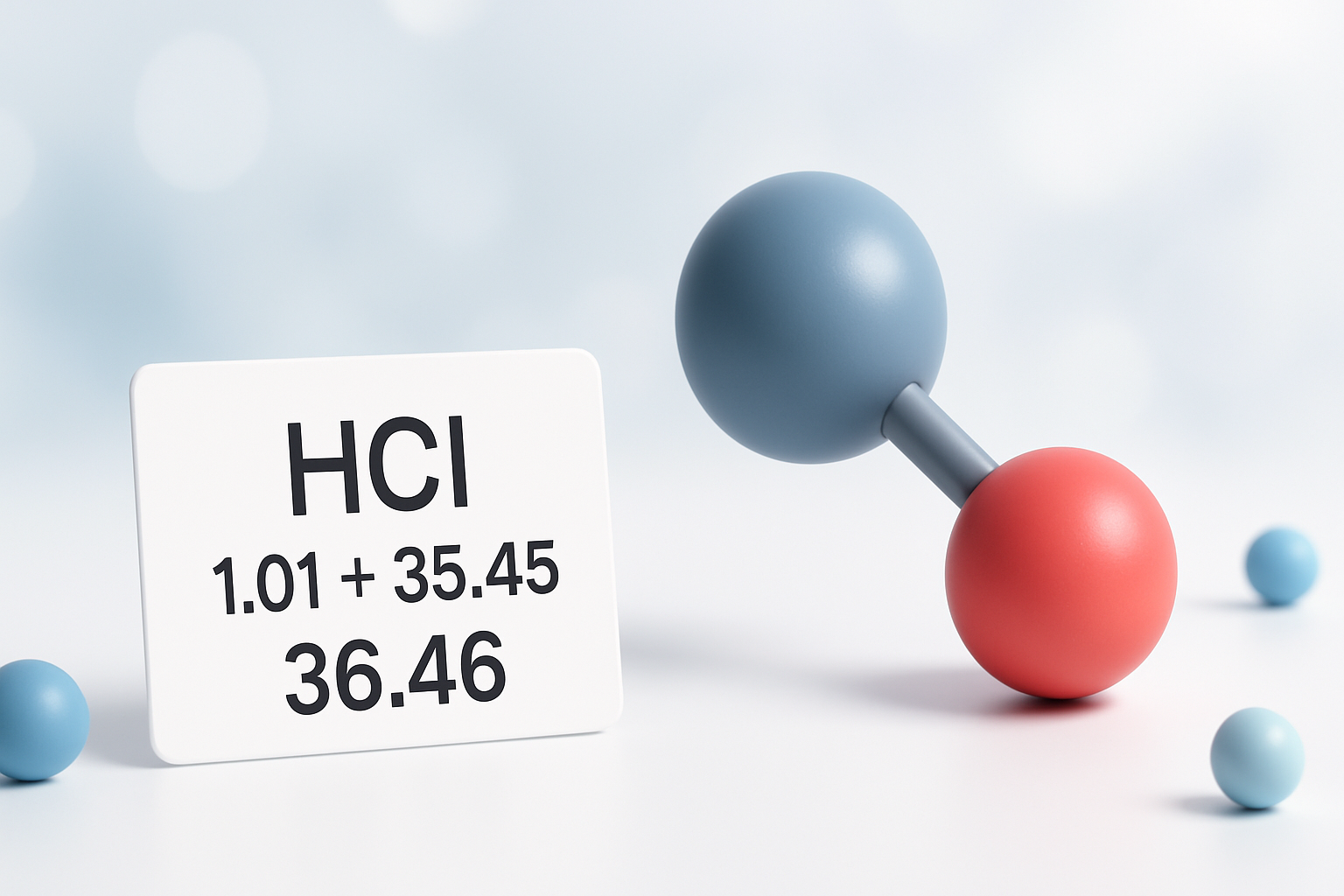
The molar mass of HCl stands at exactly 36.458 grams per mole, a fundamental value that chemistry students and professionals encounter daily. This seemingly simple number opens doors to understanding stoichiometry, solution preparation, and countless chemical reactions that shape both laboratory work and industrial processes.
Hydrochloric acid represents one of chemistry’s most versatile compounds. From digestive processes in your stomach to large-scale industrial manufacturing, HCl plays crucial roles across multiple fields. Getting comfortable with its molar mass calculation becomes essential for anyone working with chemical formulations.
Breaking Down the Molar Mass of HCl Step by Step
Calculating molecular weight requires adding up the atomic masses of all atoms present in the compound. For hydrochloric acid, this process involves just two elements: hydrogen and chlorine.
Here’s the straightforward breakdown:
- Hydrogen (H): 1.008 atomic mass units
- Chlorine (Cl): 35.45 atomic mass units
- Total molar mass: 1.008 + 35.45 = 36.458 g/mol
The atomic masses come from the periodic table, where each element’s weight reflects the average of all naturally occurring isotopes. Chlorine’s relatively high atomic mass dominates the calculation, making up about 97% of HCl’s total molecular weight.
Understanding Significant Figures in Molar Mass Calculations
Different sources might show slightly varying values for atomic masses, typically ranging from 36.46 to 36.458 g/mol for HCl. This variation stems from rounding conventions and the precision level required for specific applications.
For most classroom calculations, using 36.5 g/mol provides sufficient accuracy. However, precise analytical work demands the full 36.458 g/mol value to maintain measurement integrity.
Practical Applications of HCl Molar Mass in Laboratory Work
Understanding hydrochloric acid’s molecular weight becomes crucial when preparing solutions of specific concentrations. Laboratory technicians and chemists rely on this value daily for accurate measurements and calculations.
Solution Preparation Examples
Consider preparing a 1.0 M HCl solution. You’d need exactly 36.458 grams of pure HCl dissolved in enough water to make one liter of final solution. However, since pure HCl exists as a gas at room temperature, laboratories typically work with concentrated aqueous solutions.
Commercial concentrated hydrochloric acid usually contains about 37% HCl by weight. To prepare your 1.0 M solution, you’d calculate the volume of concentrated acid needed using both the molar mass and the concentration of your starting material.
Stoichiometric Calculations
Chemical reactions involving HCl require precise stoichiometric ratios. The molar mass allows you to convert between grams of reactant and moles needed for balanced equations.
For example, in the reaction between HCl and sodium hydroxide:
HCl + NaOH → NaCl + H₂O
One mole of HCl (36.458 g) reacts with exactly one mole of NaOH (40.00 g). This 1:1 ratio makes calculations straightforward, but only when you know the precise molecular weights involved.
Industrial Significance and Manufacturing Considerations
Industrial applications of hydrochloric acid span numerous sectors, from steel production to pharmaceutical manufacturing. Companies handling large quantities must account for molecular weight in their process calculations and quality control measures.
Quality Control and Purity Testing
Manufacturing facilities regularly test HCl purity through titration methods that rely on accurate molar mass values. Even small deviations in expected molecular weight can indicate contamination or degradation issues.
The food industry uses hydrochloric acid for pH adjustment and processing. Regulatory compliance requires precise concentration measurements, making molecular weight calculations essential for meeting safety standards.
Economic Impact of Accurate Calculations
Large-scale chemical processes involve significant material costs. Accurate molar mass calculations prevent waste and ensure optimal reaction yields. A facility producing thousands of tons annually can save substantial money through precise stoichiometric planning.
Common Mistakes When Working with HCl Molecular Weight
Several calculation errors frequently appear in both educational and professional settings. Recognizing these pitfalls helps maintain accuracy in chemical work.
Concentration Confusion
Students often confuse the molar mass of pure HCl with the molecular weight of HCl solutions. Remember that aqueous hydrochloric acid contains water molecules that don’t affect the molar mass of HCl itself but do influence solution preparation calculations.
Rounding Errors
Premature rounding during multi-step calculations compounds errors. Keep full precision until your final answer, then round appropriately based on your measurement precision.
Unit Mix-ups
Molar mass uses units of grams per mole (g/mol). Don’t confuse this with other concentration units like molarity (mol/L) or mass percentage. Each serves different purposes in chemical calculations.
Advanced Applications and Research Context
Current research involving hydrochloric acid spans environmental science, materials engineering, and biochemistry. Scientists working in these fields regularly apply molar mass calculations to their experimental designs.
Environmental Monitoring
Atmospheric scientists studying acid rain formation track HCl concentrations in air samples. Their analytical methods depend on precise molecular weight values for accurate environmental assessments.
Groundwater contamination studies also utilize HCl molar mass data when analyzing industrial pollution sources and their chemical signatures.
Material Science Applications
Semiconductor manufacturing involves etching processes using hydrochloric acid solutions. Engineers must calculate exact concentrations and reaction stoichiometries to achieve desired material properties without damaging delicate components.
| Application | Typical HCl Concentration | Precision Required |
| Laboratory titrations | 0.1 – 1.0 M | ±0.1% |
| Industrial cleaning | 10-15% | ±1% |
| Semiconductor etching | 1-5% | ±0.01% |
| pH adjustment | Variable | ±5% |
Safety Considerations and Handling Protocols
Working with hydrochloric acid requires understanding its properties beyond just molecular weight. Concentration calculations directly impact safety protocols and handling procedures.
Higher concentrations pose greater risks, and knowing exactly how much HCl you’re working with prevents accidents. Proper dilution calculations using molar mass ensure safe handling practices while maintaining experimental accuracy.
Emergency response procedures also rely on concentration information derived from molecular weight calculations. First responders need accurate chemical data to provide appropriate treatment for exposure incidents.
Future Developments and Emerging Applications
Green chemistry initiatives increasingly focus on optimizing HCl usage through precise stoichiometric control. Understanding molecular weight relationships helps researchers develop more sustainable processes with reduced waste generation.
Nanotechnology applications involving controlled HCl exposure require extremely precise concentration control. These cutting-edge fields push the boundaries of measurement accuracy, making fundamental values like molar mass even more critical.
The molar mass of HCl remains a cornerstone value in chemistry education and professional practice. Whether you’re balancing equations in introductory chemistry or designing industrial processes, this fundamental constant provides the foundation for accurate chemical calculations. Mastering its application opens pathways to understanding more complex chemical relationships and advancing scientific knowledge across multiple disciplines.
